photo: Bogdan Iordache/ Cultura la dubă
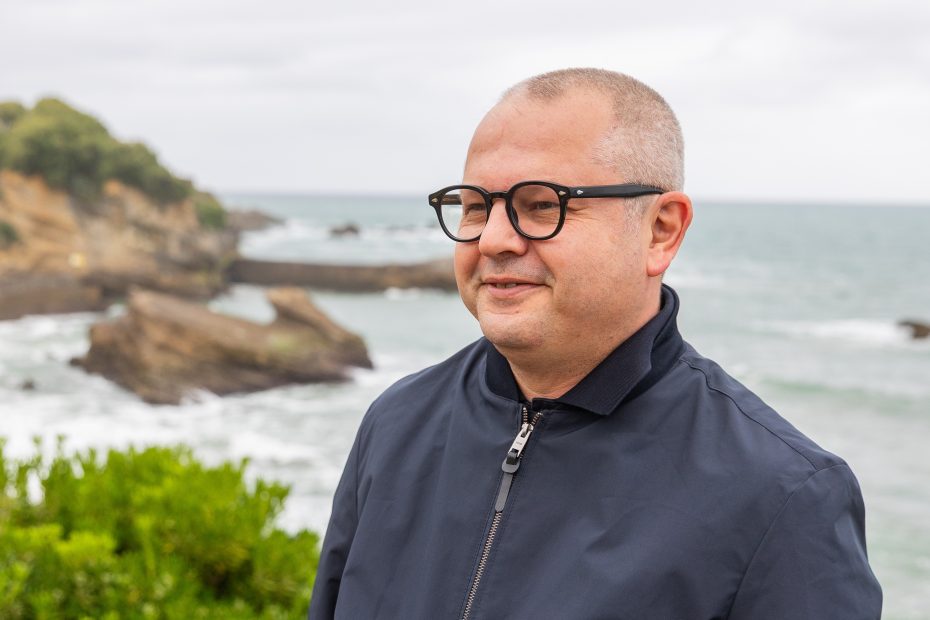
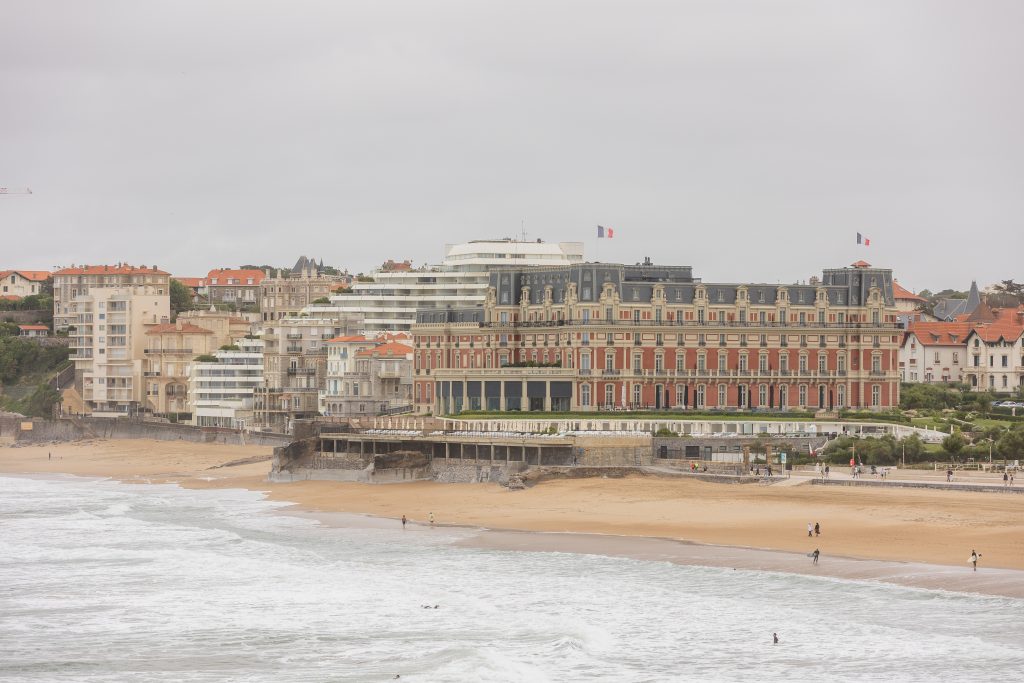
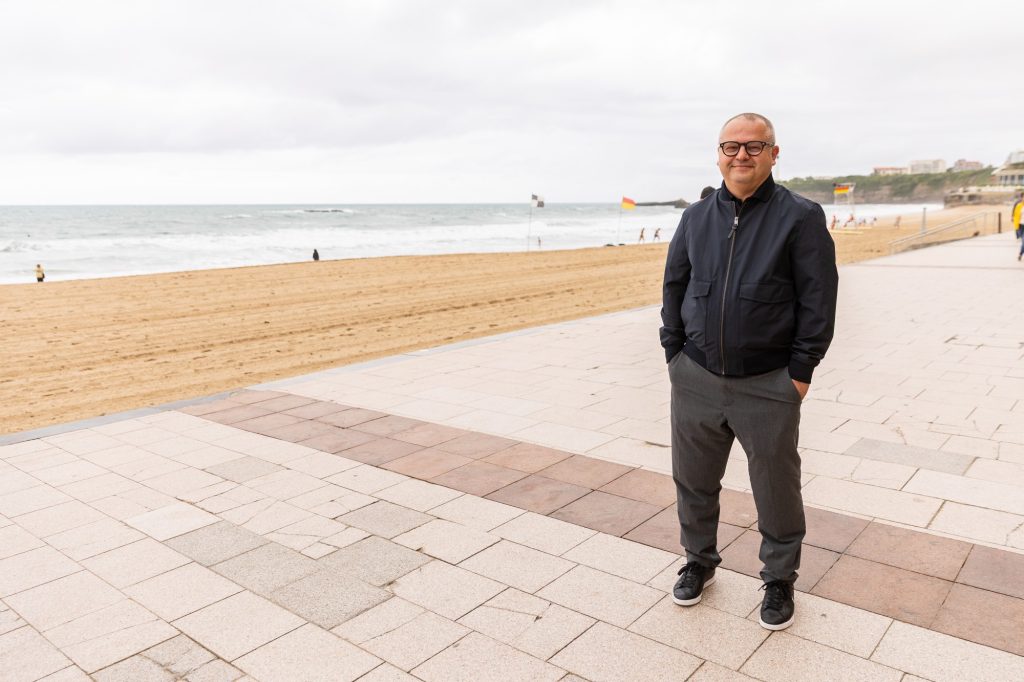
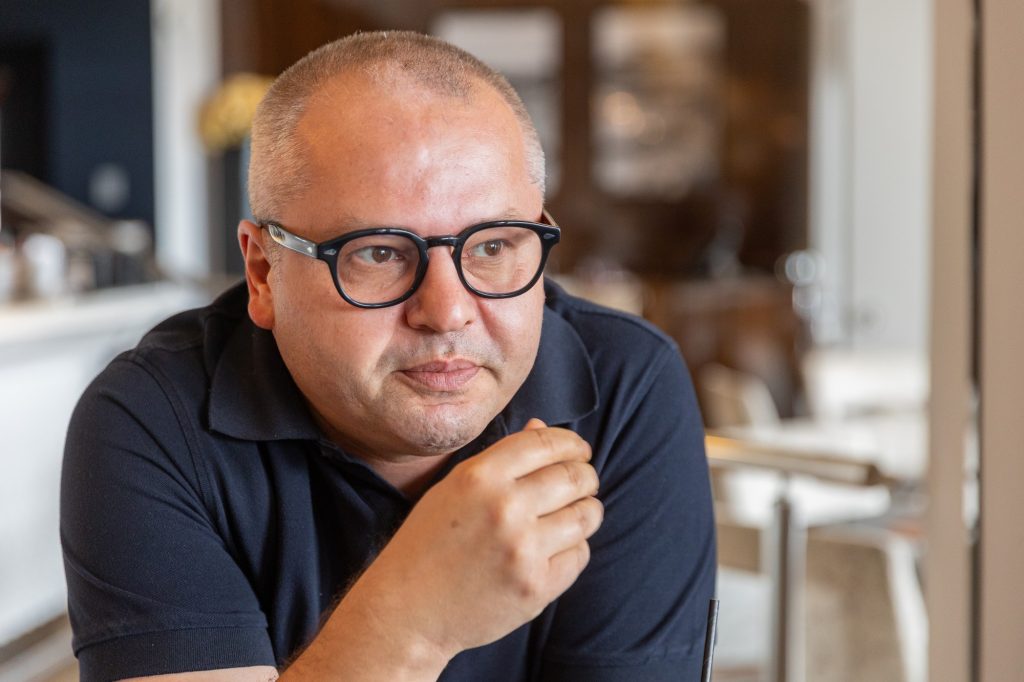
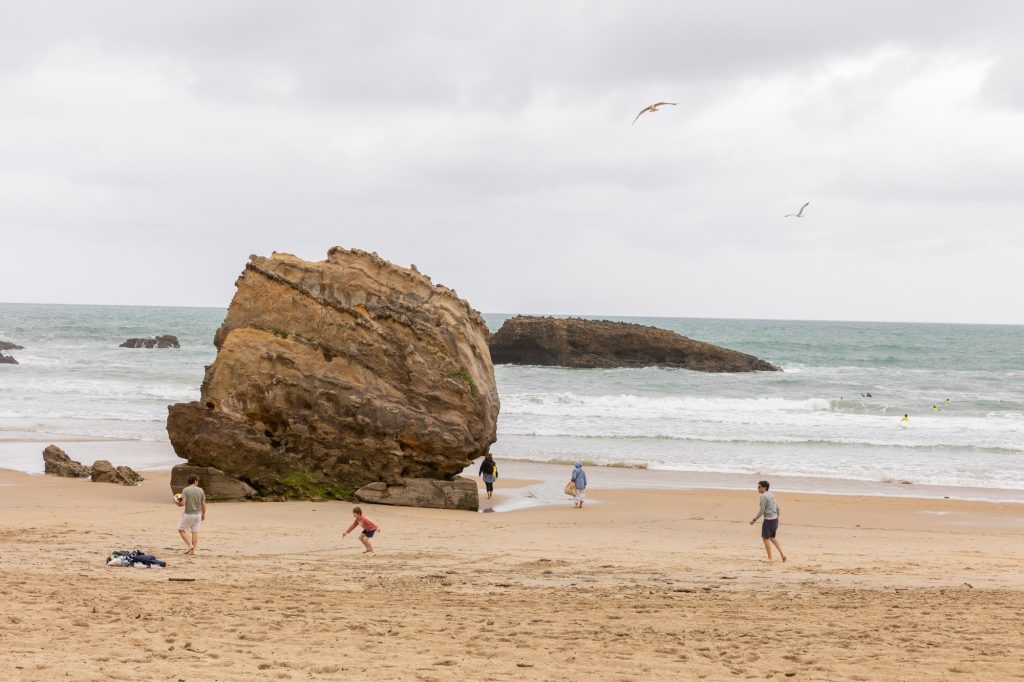
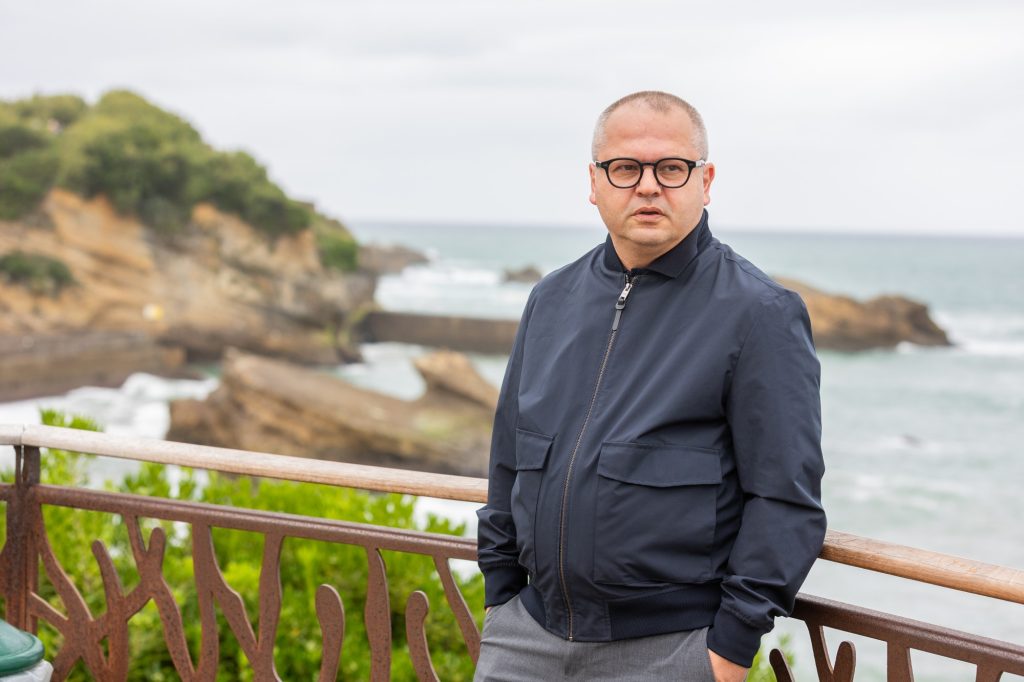
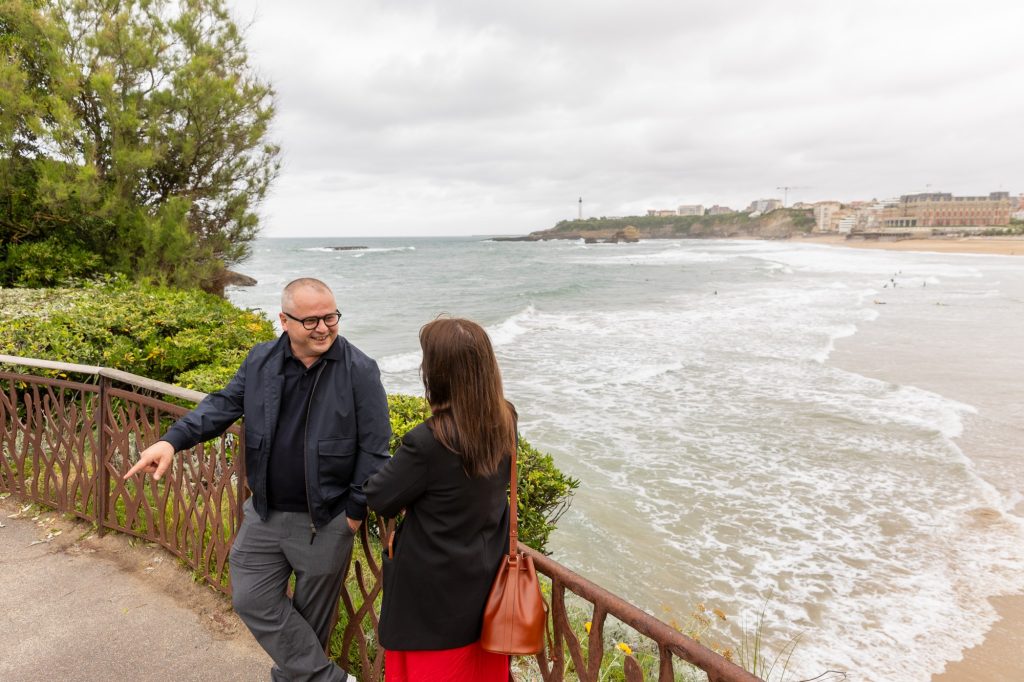
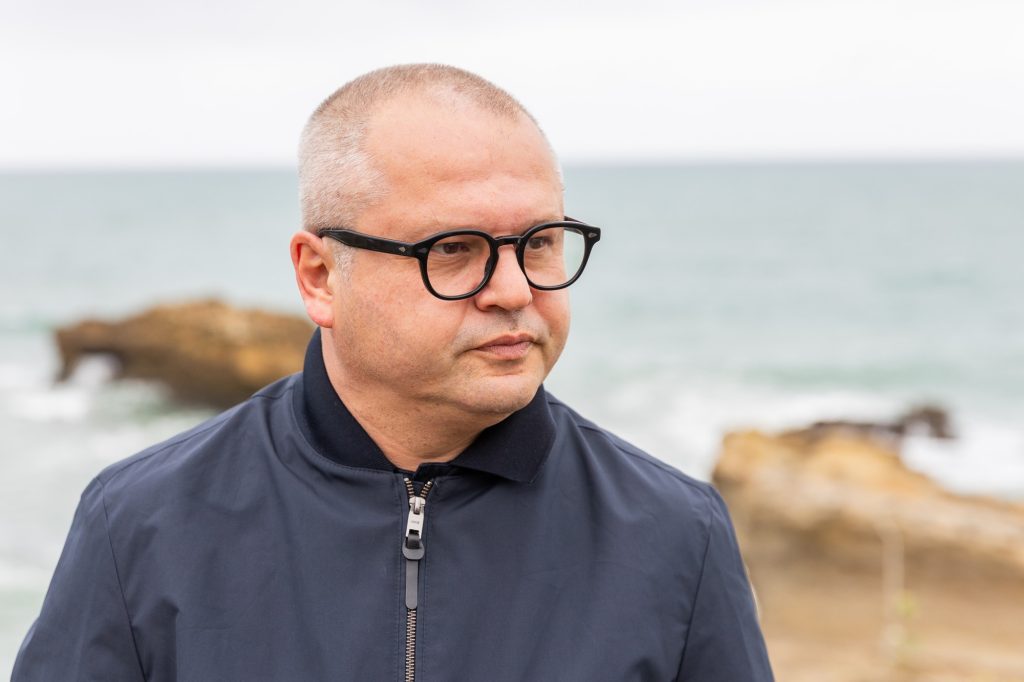
He has been living for four years in the French part of the Basque Country, right on the Atlantic coast, where he mows the lawn in his garden, shops at the local market, and refines the screenplay that will eventually become “The Costume”, his first French language film funded by the Prada Foundation. He still carries his Moldavian accent and the humor that won over cinema lovers. On the streets of the luxury resort Biarritz, he drives his car with license plates from Suceava and sometimes stops at a secret beach to take a quick dip in the ocean.
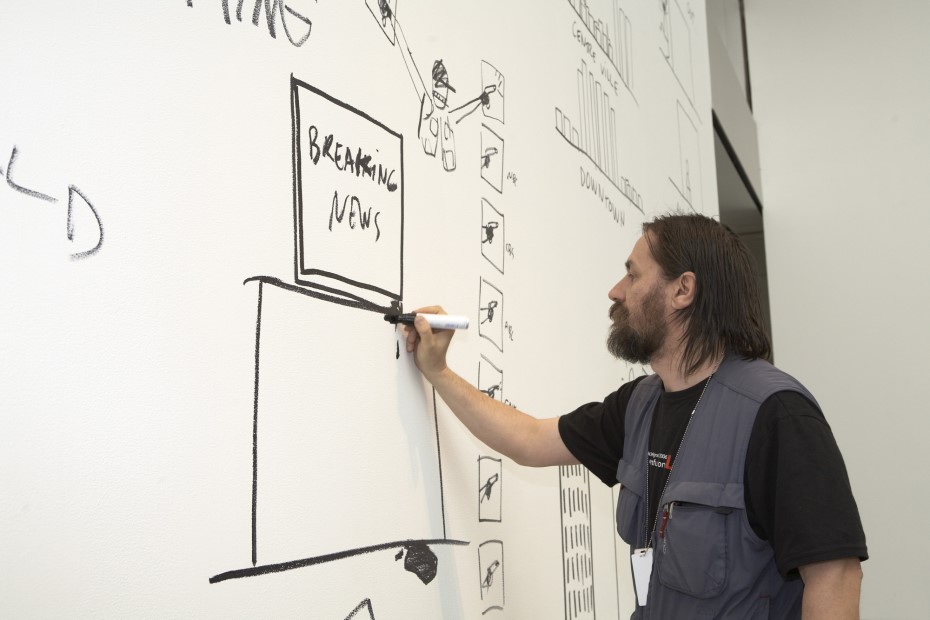
In the film world, Corneliu Porumboiu has managed to build a distinct, recognizable artistic universe, even though he is also a prominent figure of the Romanian New Wave. Essentially, he started a revolution in his own way.
Two decades after the premiere of “12:08 East of Bucharest”, which won the Camera d’Or at Cannes, the film continues to pack theaters in various corners of the world as new generations discover the Romanian director.
The filmmaker explores cinematic genre conventions, driven by a desire to preserve his personal vision despite commercial pressures or industry expectations.
On the other hand, he admits that perfectionism has often held him back or made him abandon screenplays he spent years writing.
He returns to Vaslui from time to time to play soccer with his former high school teammates. From the beach in Biarritz, he tells us why he gave up soccer, but also how he ended up making films and never looking back.
In the end, he managed to make football infinite.
***
“I wanted to have a football career until I realized I wasn’t very good.”
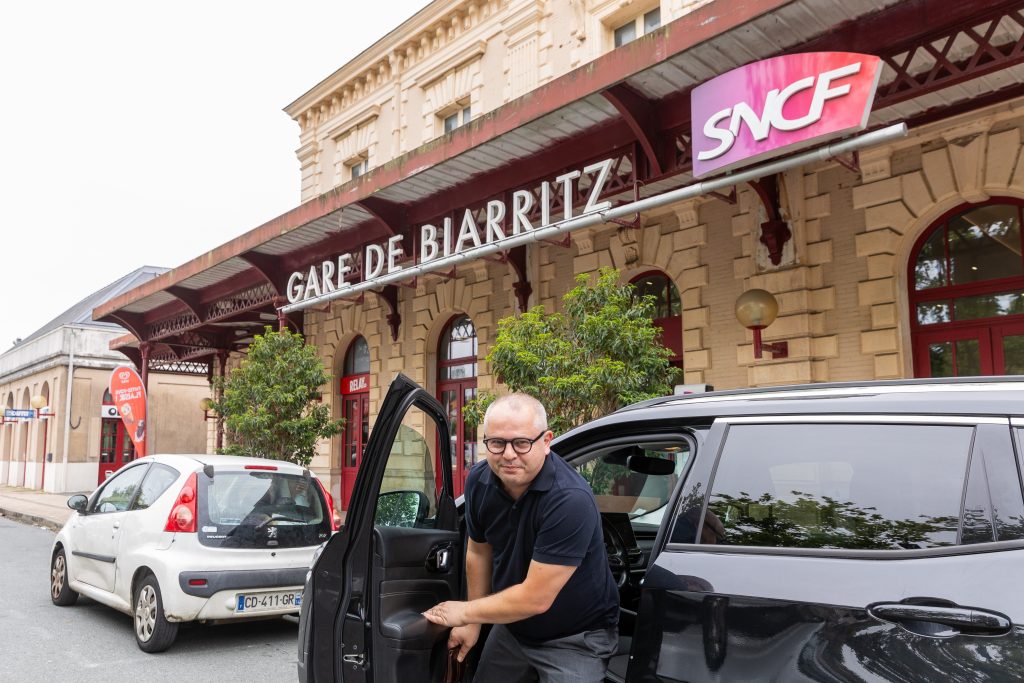
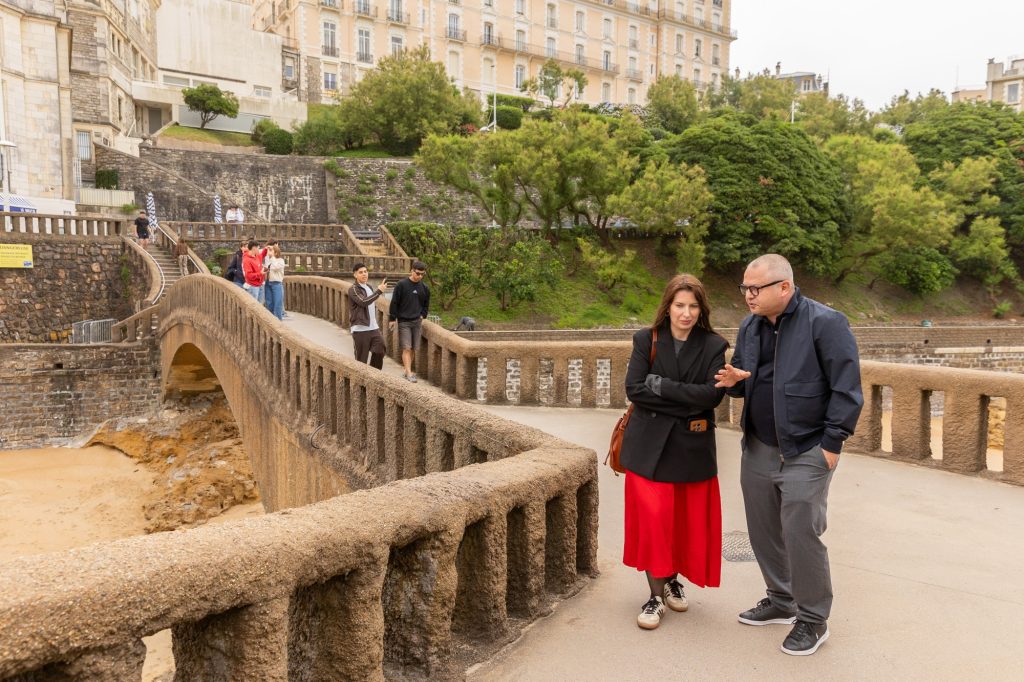
To get to Corneliu Porumboiu, who is settled in a village near the small town of Saint Jean de Luz, we took the TGV from Paris and traveled for nearly five hours. He was waiting for us at the Biarritz train station and drove us toward the center of town. “There is a major rivalry between these two towns, they have their own version of Barlad and Vaslui,” Corneliu says with a laugh.
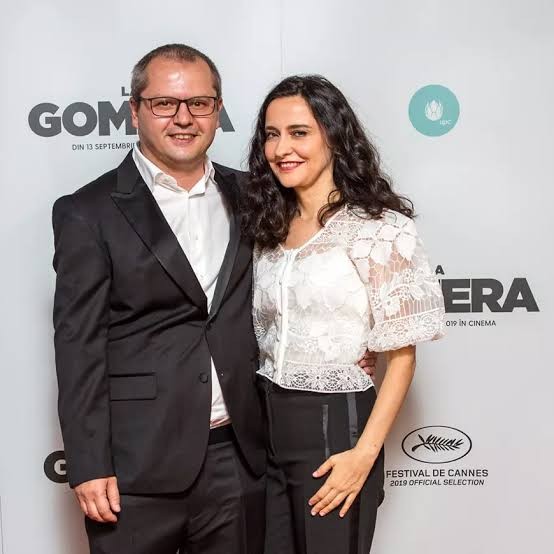
His wife, the visual artist and set designer Arantxa Etcheverria, with whom he has collaborated on his recent films, is of Basque origin, and they used to come here with their children for vacations to visit her grandparents. Around four years ago, they decided to move everyone to France to be closer to the French film industry. In the meantime, Corneliu has also become a French citizen.
“It was a project we had for a long time, a family project, we wanted to move here, I wanted to make a film in another language, and I thought the girls were old enough, one is in college, the other is starting high school now. So I said let us take this step.
In Romania, you reach a budget limit at some point, it is hard to do something different anymore. Even a budget like the one I had for The Whistlers was hard to get, because that was before COVID. Obviously, as a director, you want to work with better conditions, both financially and overall.
It is easier to be connected to people from the industry if you are here. Also, since the film takes place here, it was very important for me to live in this area.”
Corneliu Porumboiu’s story begins in 1975, in an apartment building in Vaslui. When he was born, his mother was a Romanian language teacher and his father, Adrian Porumboiu, a football player, was ending his playing career to start one as a referee. He would go on to become one of the most famous Romanian referees, with an international career, as well as an agricultural businessman and eventually the owner of the FC Vaslui football club.
Football was a constant presence in the life of Corneliu, who played professionally himself as a central midfielder. In fact, his earliest childhood memories are tied to football.
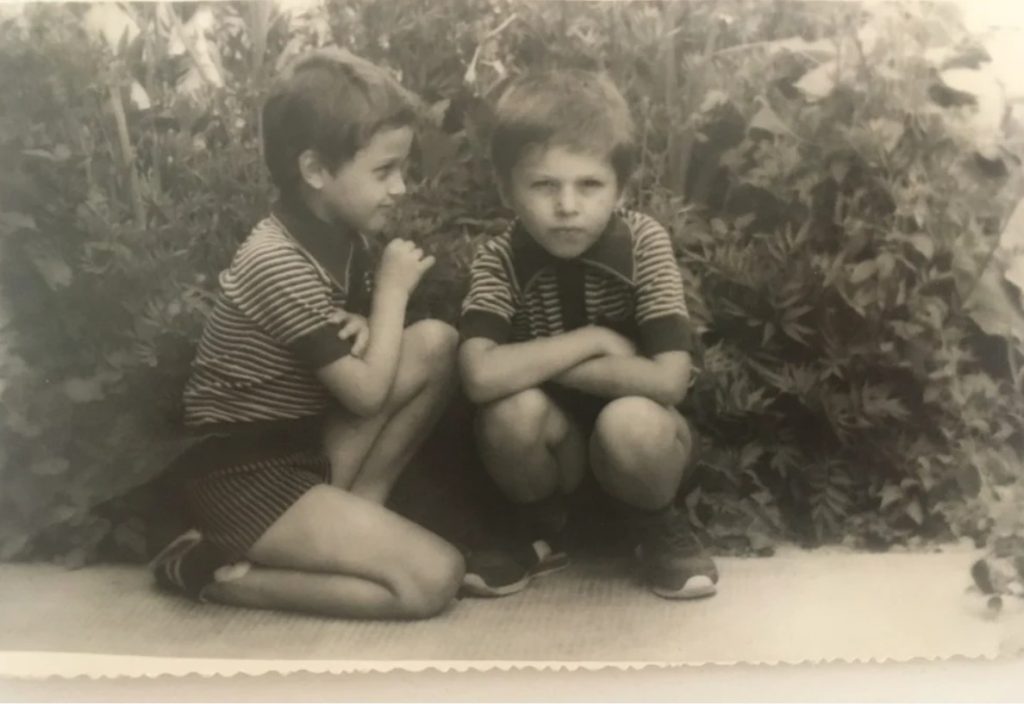
“I lived in two neighborhoods in Vaslui, in one until I was seven. Then we moved. I remember there was a military unit across the street and I used to play football with the guys from there. At one point, I wanted to make a career in football, until I realized I wasn’t very good, hahaha.
I was on the team at the School Sports Club – CSS in Vaslui. I was already at the math and physics high school, while my other teammates went to the sports high school. I had a more demanding schedule at school and it became hard with practices every day and games on the weekends. I would finish classes at two, have practice at three, finish at five, and by the time I showered it was getting late. I did not even have time to eat, because if I ate beforehand, I could not practice well.
And in the end I would return home and had to do my homework, and I had also started reading a lot during that time. (Editor note: his mother encouraged him to read). I also had an injury that kept coming back and I thought, man, this is not practical.
But I still love football very much today.
Do you still play from time to time?
Very rarely. The last time I played, in Vaslui, between Christmas and New Year’s Eve with my former teammates, I did not warm up, ended up with a torn ligament, and now I have to do physical therapy. It was also around zero degrees outside, and someone told me: man, warm up well! I said no, I will start slow with some passes, I won’t go hard, I mostly came to see the guys. Then I made a sudden move and bam.”
“A cousin took me to the Cinematheque. I liked it a lot and started going more and more often.”
As he was getting closer to his high school graduation exams, he wanted to become, in turn, an archaeologist, a sociologist, or to study geography. In the end, he took the entrance exam for the Academy of Economic Studies – ASE alongside some classmates from Vaslui, and moved to Bucharest.
Only then would he discover the fascinating world of film.
“A cousin took me to the Cinematheque once. I liked it a lot and started going more and more often. They had those months dedicated to a single director, a Fellini month, an Antonioni month, then Capra. The Cinematheque was very good, you could really build a culture for yourself.”
He was still a student at ASE when he decided to take the entrance exam for film school, but he failed in his first year. He finished his degree at ASE and then got in on his second attempt at the National University of Theatre and Film – UNATC. And that is how he started working on his student films.
A few years ago, director Radu Mihaileanu told us, also in an interview for the France Week series, how he saw the young Corneliu on his film set.
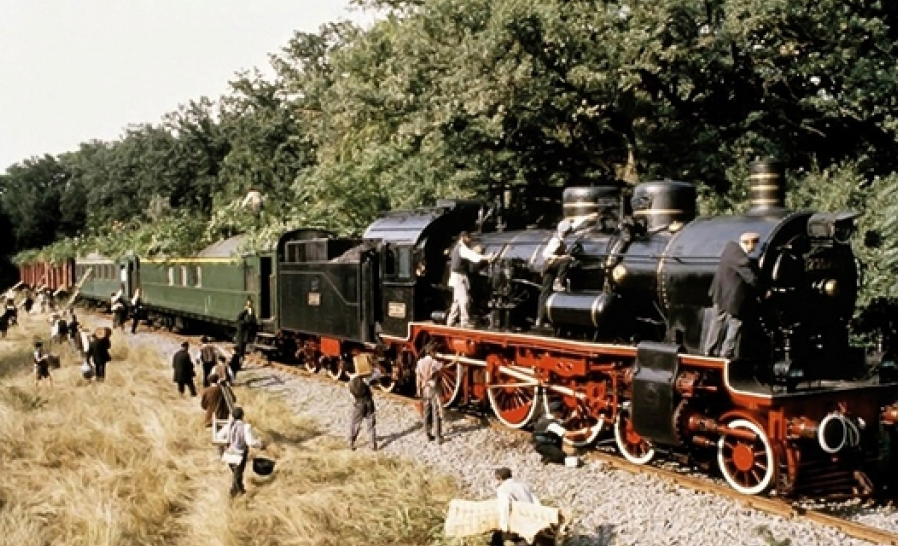
“When I filmed Train of Life in Vaslui, I was staying at the most prominent hotel in Vaslui, which belonged to a very wealthy man, Adrian Porumboiu, who came to see me at dinner and told me: <Excuse me, I also have a boy who would like to make movies. Can he come to the set tomorrow?>
The anecdote is fabulous. He came and, poor guy, stood a hundred meters behind the camera, very far away, he was so shy. And I told my French assistant: <He will never make cinema. He is standing to far away.>
When we met after he won the Camera d’Or at Cannes, I told Corneliu Porumboiu: I bet that you would never make movies. I am very happy that I was wrong.”
Corneliu now tells us his own perspective on that film set.
“It was a high angle shot, very complex, with a lot of preparation, with about two hundred extras and costumes, the train had to pass, and some people had to jump out of it. It was something super difficult, an incredible display of logistics. I was not used to anything like that. Even to this day, I have never shot a sequence of that kind.
Obviously, seeing the madness there, I told myself, why should I even get in the way? If I do not stand in the right spot, I might even end up in the frame of a reverse shot, hahaha.” (he laughs)
What was the first screenplay you wanted to turn into a feature film?
It was one that I never ended up making, though Igor Cobileanski later adapted and shot it.
But why didn’t you make it yourself?
Because I had worked on that screenplay for about two years. And it wasn’t working out for me, at a certain point it became mechanical. I had received funding for it from the National Film Center for my debut, and I even got a Cannes residency with it in Paris. But later on, I wrote “12:08 East of Bucharest”. And I never went back to the other one, it felt too technical to me.
After that, I told my dad: will you help me make this film? Because I couldn’t make it with money from the CNC, since I had given up on the debut project.
How was “12:08 East of Bucharest” born?
I saw a TV show where three people were talking about the revolution. I got angry because it was the same thing with the 12:08 timestamp, like, man, how can you talk like that? But I turned off the TV and the story stuck with me afterward, it was almost like a joke. Man, was there a revolution in Vaslui if people only went out after 12:08? And at one point I said: let me write this story. I wrote it very quickly.
Regarding the general atmosphere of the film, what still remains very strong in memory is the humor. Where does your humor come from?
“I do not know, I am actually very serious by nature. My wife says you would not even believe that I make these kinds of movies, hahaha. I am quite serious,” Corneliu says with a laugh.
Out of the entire process of working on a film, which part do you like the most?
Directing.
“I cannot stand writing anymore because I have spent so much time doing it. I had entire years where all I did was write between the projects I made.”
Corneliu Porumboiu, director and screenwriter
There are also projects that never ended up getting made.
And you didn’t make them because you lost faith in them?
Yes, at some point it feels like the story just doesn’t hold up anymore, you know? You work, you try things out, you make mistakes, maybe it is not right, not everything has to work out, and a lot of time passes from the moment you write to when you actually start filming.
But do you think you are a perfectionist by nature?
Yes. And over time I learned that it can also be a flaw.
Because you feel like it holds you back?
Yes, or sometimes you can end up with a kind of rigidity, both in the screenplay and in how you actually make it. For example, with ‘When Evening Falls on Bucharest or Metabolism’, a film that I still laugh at when I watch it, it is funny, at least to me, I rehearsed an enormous amount with the actors and on location.
There are many behind the scenes aspects, like rehearsing, but not rehearsing too much. I try to manage it so that everything doesn’t become rigid.
You said you do not like the writing part anymore, would you like to try making a film based on someone else’s screenplay?
Yes, I would, if possible, but I think I would still have to give it at least one pass myself. Especially with the dialogue, because I have my own style of dialogue, and that is where the humor comes from, it operates through the dialogue. For example, in ‘Metabolism’, it helped me to have what the actor says in with their reactions.
Because in cinema, when a character speaks, it is taken as an absolute truth. It is very hard to reestablish it otherwise. And that is something I like to play with, having a contrast between body language and what the person is saying. And when it comes to the dialogue, to keep the humor, my dialogues are very much like a game of ping pong.
Following his successful debut with “12:08 East of Bucharest”, Porumboiu went on to win the Un Certain Regard prize for “Police, Adjective” and the Un Certain Talent prize for “The Treasure”, while his film “When Evening Falls on Bucharest or Metabolism” was selected for the official competition at Locarno. His passion for soccer found its place in the documentary films “Infinite Football” and “The Second Game”, in which he and his father commentate on a 1988 Steaua vs. Dinamo derby match that was refereed by Adrian Porumboiu. He attended the Berlinale with both documentaries.
“The Whistlers”, filmed outside of Romania, marked his clear departure from the stylistic elements of the Romanian New Wave and also earned a selection in the official competition at Cannes.
“The Costume” – the first French language film directed by Corneliu Porumboiu
Now, Corneliu Porumboiu is polishing the screenplay for the film “The Costume”, which will be produced by Lumen. MK2, the company founded by Marin Karmitz, a Frenchman of Romanian origin, with whom Porumboiu also collaborated on his last film, “The Whistlers”, will co-produce alongside Cristian Mungiu’s company, Mobra Films, and Komplizen Film from Germany.
The project is also supported by funding from the Prada Foundation and will star a well-known French actor. Filming is expected to take place in the area where the director currently lives.
Looking back, he admits that the awards he won helped his career, but he does not consider them life changing, nor does he agree with making films solely for the purpose of getting selected by a major festival. In fact, he discourages young filmmakers from equating success with awards.
“In our industry, they say only your last film matters. So that is pretty much how it goes in cinema.
Is the success of a film also measured by its longevity? By the fact that it still packs theaters twenty years later?
Well, that is actually the ultimate test of a film. If it touches on something universal that remains relevant beyond the sociopolitical context of its time, I think that is the biggest achievement. Besides, when you make a film, you place yourself within a certain cinematic tradition; in the end, we are all influenced by films we have seen before.
And if you somehow manage to add something new, to not just repeat things, that is another major goal. You are not just telling a story, because you can do that in literature too. It is how you tell it that matters.
On the other hand, there is also an overvaluation of novelty. Wow, it is new, so it must be good. There is a flip side to that too.”
New voices need a bigt of time, to grow, to form, they need to make two or three films.
Corneliu Porumboiu, director and screenwriter
I also receive films from young directors from time to time, I talk with them, I sometimes watch rough cuts, and they are good. But they need time.
Also, if you make a film, it is not healthy at all to think only about festivals, because if you are not selected, it creates a kind of frustration and misunderstanding.
What should an honest approach in cinema be for? To answer the director’s inner searches, for the audience, or for festivals?
I think it depends on where you are in your life. For example, right now, I am very interested in having the film open up to the audience somehow. It is very difficult to distribute a Romanian film. It is true that a major festival helps you, an award helps you, and I pretty much know what kind of numbers I got with each film. But in the end, Western cinema, even French cinema, is built around stars. So the star brings you funding, and then they bring the audience into the theater.
In Romania, for example, people go to the theater because Marius Manole is on the poster. There is a star system, you know?”
“Of course I’m interested in the audience,but I also want to remain in a personal zone.”
Corneliu Porumboiu, director and screenwriter
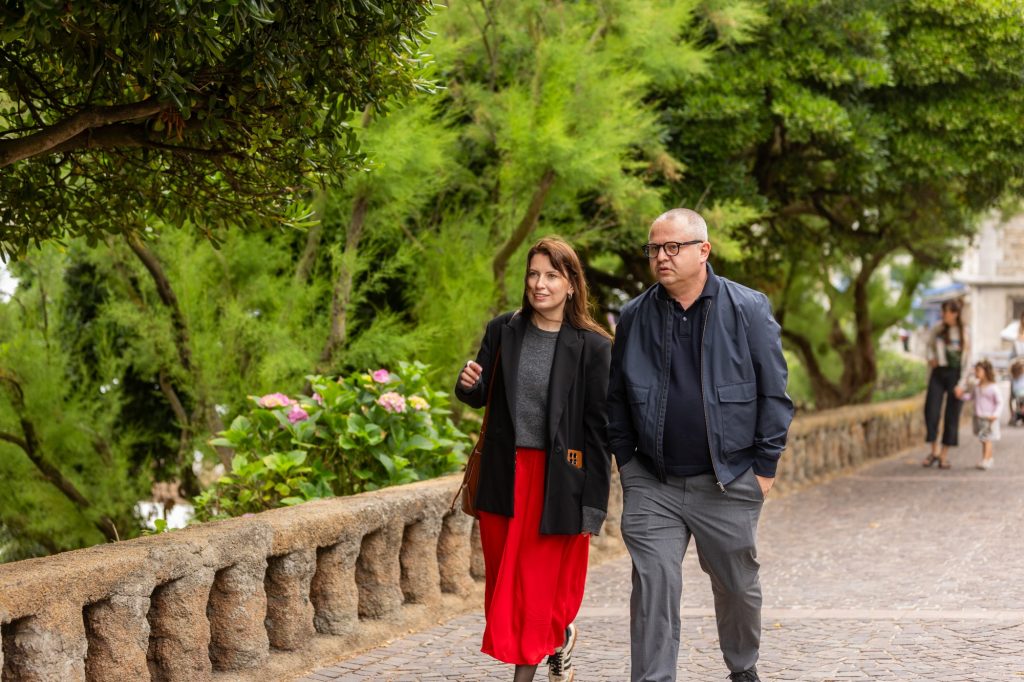
Corneliu now lives in a house with a garden near the Atlantic Ocean, on the border between France and Spain. “I go to Spain to buy my cigarettes because they are much cheaper,” he confesses with a laugh. He goes to the local cinema to watch movies and to the market to buy fresh groceries.
Do you cook?
Yes, but I am not some major talent. The cool thing here is that even if you are not particularly good at cooking, the food still turns out very tasty because everything is locally produced. The beef has flavor, and so do the vegetables, the fish, and the seafood. Even at the supermarket, everything consists of fresh local products.
How else has your life changed since you moved here?
I work, and I am much more focused on my work, that is clear. And besides that, it is very pleasant here, as you can see. I know the area very well; I have been coming here every summer for twenty years now. My wife is Basque, her family is here, and I know the people.
How did you meet your wife?
I think it was around 98 or 99, she was working in Romania. She studied set and costume design in Strasbourg and was working with the theater in Iasi. We met through an actress friend. After that, we kept a long distance relationship going for a while.
Are your daughters interested in film or acting?
No, and I did not force them, although they have a good eye for art—but that is something you have to cultivate over time. Besides, they do not want to do this. They see how hard we struggle, hahaha… and they say, ‘no thanks!’ (laughs)
But why is it so agonizing to make a movie?
I do not find it agonizing because I love it, but from the outside, if they see someone just sitting and writing all the time: <what are you doing, dad? Writing. How’s that project of yours going? When are you going to make it?>(laughs) My girls also make fun of me: <When are you going to make your film?>
Yeah, what can I say, it has taken a long time.
How do you explain to the people reading this article why it takes so long to make a movie?
It also depends on everyone’s individual pace and the timing, because you can have periods that move faster. It depends on the project and the budget. With this project I am working on now, since it requires a larger budget, it took some time to secure the money. Foreign producers look at the box office: let’s see, how much did your last film make.
What is your opinion on shooting a movie with a phone?
Yes, you can do it, but on the other hand, where do you distribute it? For a movie theater, it needs to be a certain type of product. It is nice to say, yeah man, I am making it with a phone, but where do people actually watch that phone-shot film?
In the end, the spectator makes an effort to get to the theater. They pay for a ticket, they take time out of their day, and the movie theater is somewhat conditioned by a certain type of spectacular element.
But for those who still cannot manage to raise the necessary budget, could it be a solution?
Sure, rather than not working at all, it is important to just make it that way. Just don’t have high expectations. Not everyone is well-known like Radu Jude; he already has his own established audience, he has been doing this for a long time, he had good films before this, he shoots with a phone, but he is actually working with the principles of a 35mm or 16mm camera. That is a different thing.
You were telling me at one point that you taught at UNATC, but you quit because the students were not serious and would not show up to class. Would you ever want to teach again?
That was at one point, but the truth is it was very demanding. I was losing a lot of time for my own projects. I had two days a week of six-hour classes. After that, they would send me screenplays, I would write notes, so that took up another day. And they would also poke fun at me because I was an assistant; at one point I would call them out, ask them what they did with the screenplay, tell them they had that specific problem to solve, and then they would make fun of me: ‘Oh, Mr. Laurentiu Damian approved it just the way it was.’
Corneliu Porumboiu was celebrated this year at TIFF, where a retrospective of his films was the highlight of the edition. “A retrospective feels a bit like… (laughs) I say I still want to make a few more movies, my career doesn’t end here, hahaha.”
Whenever he gets the chance, he participates in workshops with students and tries to stay connected to future generations of Romanian directors. However, he is left with the regret that despite the international success of Romanian filmmakers, movie theaters in our country have disappeared, one by one.
“Even if we invest in theaters from now on, my opinion is that it is quite late because that type of consumption no longer exists. I have friends who have lost the habit; they prefer to go to the theater, for example. So it is very difficult to bring back that kind of cinema consumption. We have actually lost two or three generations.
And then came the mall generation, but if you go to the mall, you lose your mind. For this kind of auteur cinema, even if you start rebuilding the theaters, I think there is a much greater need for investment in film culture. It needs to come as a package deal with something more. Not just having the screen.”
***
This article is part of the”French week” series, a project by Cultura la Dubă, supported by BNP Paribas