photo: Bogdan Iordache, Cultura la dubă
Born in Bucharest in 1964, Sophie Negropontes left Romania when she was just 12 years old. Today, she owns one of the most important art galleries in central Paris—Galerie Negropontes. Last year, she expanded with a new location in Venice.
She is the granddaughter of General Eremia Grigorescu, a hero of the Romanian army at Mărășești and Oituz, after whom a street in Bucharest’s Icoanei neighborhood is named. She is also the granddaughter of Elena Negropontes, a descendant of the famous Greek merchant family Negropontes. Her father was Dan Eremia Grigorescu, one of the most important Romanian photographers, active in Romania and abroad from the 1950s to 1989, and a correspondent for Radio Free Europe.
Her relatives were abused and terrorized by the Securitate (communist secret police), and her family had to start over from scratch in France after 1974.
“My life is a story about luck, and my journey after leaving Romania is a miracle,” says Sophie Negropontes in an extensive interview with Cultura la dubă.
***
A few years ago, we discovered Galerie Negropontes in Paris while seeing an exhibition by the Romanian artist Mircea Cantor. That’s how we learned the gallery’s owner was of Romanian origin, and we were curious to know more about her story.
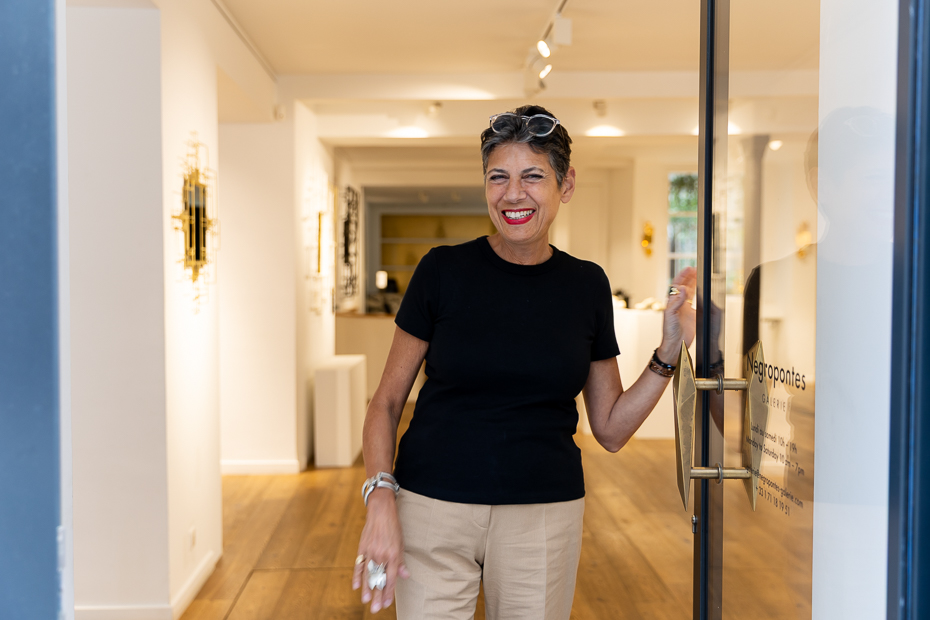
It was a national holiday in France in June when Sophie Negropontes opened the doors of her gallery for the Cultura la dubă report. The gallery owner, whose space is located right between the Louvre and the Pinault Collection, greeted us with a smile, speaking perfect Romanian.

“How did you manage to preserve your Romanian so well?
I always spoke and still speak Romanian with my mother,” she told us.
She introduces herself as half-Romanian, half-Greek, with French culture. She feels a strong connection to her Romanian roots thanks to her parents, who were both Romanian, but her childhood memories in Bucharest are mostly tied to the trauma her family endured during the communist era.
“Everything was confiscated. My grandmother was paralyzed when the Securitate guys came to deport them to Bărăgan. In the end, they decided it was too complicated to deport her because she was completely paralyzed. So it was more complicated to move her than to leave her.We were constantly monitored. When I went to school, there was a Securitate guy in front of the door.
Sophie Negropontes, founder of Galerie Negropontes
There was a feeling of fear, a lack of freedom, an inability to trust. I know we used to listen to Radio Free Europe, and I was little, going to school, when my dad told me: ‘Even if someone shakes your hand, you must not say that we listen to Radio Free Europe.’
My godfather was deported to Siberia for nine years, my grandfather spent ten years in prison because he was a judge before. The entire family was at least beaten by the Securitate,” Sophie Negropontes begins her story.
Her father, the photographer Dan Eremia Grigorescu, a friend of Mihail Sadoveanu, published a series of photo albums during the communist period that later won international awards in Washington and Leipzig. Thanks to his art, foreigners were able to discover fragments of Romania: Voroneț, Folk Art from Northern Moldavia, the Danube Delta, and Brâncuși’s works in our country.

He also produced television reports for “Teleenciclopedia.” He visited and photographed major European cities, bringing back unique images from a world inaccessible to ordinary people in Romania.
“He managed to leave for a few months to make some TV shows and albums. He made an album about Rome, one about Paris, and one about Venice. My dad used these albums to show another side of France and Rome. He brought them to Romania at a time when everything was closed off, and people didn’t know what was happening in Paris. At one point, he was caught on the street and they cut his beard with a knife because you weren’t allowed to wear a beard in Romania.”
In 1974, the photographer and his wife left Romania for good, and Sophie, who was ten years old at the time, remained in her grandmother’s care. Two years later, she also managed to leave the country with the help of the Greek government.

At that time, there were some economic ties between Romania and Greece, and the Negropontes family was quite well known in Greece. We requested to leave for a two-week trip to Greece. I left with a small suitcase, and then I arrived in Paris, where my parents were waiting for me. I got there at the end of August, and by September 15th, I was in school.
Did you know the language?
A little, very little. Not enough for it to be easy, in any case.
And how did your parents integrate? Did your father continue to work as a photographer?
Dad worked very little in photography and started working for Radio Free Europe as a journalist.
After the Revolution, my dad and I were among the first people to enter the free Romanian embassy. He did the first free broadcast from the embassy. It was a very emotional moment.
Sophie Negropontes, founder of Galerie Negropontes
I remember at the time I had a lot of friends who told me that what happened with Ceaușescu was not dignified, that it wasn’t worthy of a democracy.
But after 45 years of communism, how could Romania know what a democracy looked like? Two generations of people had no information about democracy, not even the culture or education for it. How could they know what democracy was like?”
Did you ever think of returning after the Revolution?
I wanted to go with great enthusiasm on the first medical aid trucks. But I was 24, and my parents were very stressed to see me leave for a world where no one knew exactly what was happening. Plus, it wasn’t possible because my dad was very ill. He died shortly after, in 1990.
Sophie Negropontes has a degree in economics, but she inherited her father’s interest in art.

“At an age when young people tend to go to shopping malls, I would go to museums. That’s how I was raised by my parents.
I went to business school, and right after, I went to Hong Kong, where I worked for a French perfume company. I came back because my father was very sick and I worked for a textile group. Then, I was a partner in a web company, a search engine for websites. I handled the commercial launch. I’ve always done commercial launches or product launches; I’ve always worked with creative people.”
She opened her gallery in 2012 and inaugurated it with an exhibition dedicated to her father.

It was a crazy moment when I said to myself that I wanted to be in a field that I truly love and do what I know how to do, which is product launches. The first exhibition was with my father’s photographs—portraits he took in ’68—and a design piece.
Then I started working with a French designer. Everything was born from the photo album Brâncuși. That’s how the idea came to create sculptural, architectural furniture—unique pieces, limited series, or made-to-order.
How did you manage to promote the gallery in a market where there were already so many other galleries? How does someone new succeed?
By working a lot. With a lot of hard work and a lot of luck. I had zero network and zero contacts. Things happened organically. One relationship led to another. Maybe there was a big order that allowed us to finance a new collection, which was successful, which allowed us to be at a professional fair, then a second professional fair, and so on.

When I created the gallery 13 years ago, gallerists at the time would just wait. At a fair, you would just wait. People would come, say they were interested in these things, and nothing would happen right away.
I don’t know how to work like that. I would follow up, call people back, reconnect, schedule meetings, and from that, the business was born.
Did you know from the beginning when you opened the gallery what kind of art you wanted to promote here? Were you interested in anything specific?
The art I love most wasn’t actually the art I promote. I love 15th- and 16th-century Dutch and German painting, the Renaissance, and Surrealism. I had a very academic education and I continue to do very academic visits.
But I have an interest and a curiosity for many things. Some artists are very interesting, not because I like everything they do, but because their journey and their explorations are interesting.
What catches your attention in an artist that makes you decide to promote them?
The pieces and their quality, of course. What they want to say with them, hoping it’s not too obscure. I’m convinced that a piece can stand on its own. If it’s accompanied by two pages of text to read, that’s a bonus. A piece can be bought, placed in a living room, in a bedroom, and so on. But there are some contemporary pieces that only exist through their discourse.
If it’s a railing made from a piece of aluminum and it’s explained over four pages that it represents the boundary between life and death, paradise and hell… okay, but what do you do with that railing? Do you put it in the middle of your living room?
So, for me, there is a part of contemporary art that doesn’t convince me.

At her gallery, Sophie Negropontes promotes creators of luxury decorative pieces that combine artistic flair with high-quality, original materials. She also works with photographers, sculptors, and, more recently, jewelry designers. Among the artists she collaborates with are the Italian Gianluca Pacchioni, the Romanian Mircea Cantor, and the French couple Martine and Jacki Perrin. The gallery is located on Rue Jean-Jacques Rousseau in Paris, at the end of which the Cartier Foundation is now being built.
“I am very directly involved in the artistic selection and the relationships with the artists, which is, in a way, the particularity of the gallery. I work with a relatively small number of artists. Many galleries of the same size work with 50 artists; I work with 15. So I dedicate time to each one.
Then, I need to get along with them. That is a fundamental thing. On a human level, not just an artistic one. On a human level, first and foremost.
You mentioned that not all contemporary art convinces you. Can you explain who and how the value of an artist is determined? How does an artist become sought after by collectors or exhibited in major galleries and museums?
In contemporary art, it’s also about marketing. For example, I once saw a South American painter at Art Basel whose painting was selling for one million euros. A year before, it was at 200,000, and a year before that, it was at 15,000. So something happened that made that work popular or made it picked up by a very, very well-known gallery, and the artist’s reputation grew through the gallery’s name.

It’s a pretty complicated world. An artist’s rating is set at auction houses. When you put a piece up for auction, it either sells or it doesn’t. If it doesn’t sell, that’s pretty bad. At the auction house, they always set a low starting value to give it room to grow. It can sell for a lower price than the gallery price. Or an artist’s piece can sell for 2,000 euros at auction, while in the gallery, the same artist has another piece for 30,000 euros. But they have nothing to do with each other. The artist’s rating, however, for the collector, is at 2,000 euros.
Because I have some artists who work exceptionally in glass, for example, to build their reputation, I didn’t put them up for auction. Instead, I worked with several museums, and they have pieces exhibited in multiple museums. This doesn’t give a commercial value, but a cultural value.
And how did you manage to convince the museums to exhibit or buy them?
With a lot of hard work and thanks to them, because they are very good artists in a specific niche, the glass pieces.

But do museums have dedicated people who visit galleries to discover artists?
Nobody visits anymore because they don’t have the budgets. So I have to go to them.”
Last year, Sophie Negropontes also opened an exhibition space in Venice on the Grand Canal as part of the Masieri Foundation.
“It’s a collaboration with the university that runs this foundation, and we restored the place, which is an old brick facade, while the entire interior of the building was done by Carlo Scarpa, one of the most famous Italian architects.

Why did you want to expand to Venice?
“Because I was doing a lot of fairs—three or four a year, first in Paris, London, New York, then I stopped doing London and Paris, and did New York, Miami, and Los Angeles last year, plus Saint Moritz in Switzerland.
I believe that in Venice, people talk about art much more than anywhere else for a long period of the year. The Biennale lasts for nine months. At a fair, art is talked about for four or five days.
I was doing shorter exhibitions here in Paris, and I decided to do exhibitions that would last longer, four months, perhaps with more depth, giving people time to come and talk. In Venice, I have an exhibition on three levels for a year.
What are the challenges for a gallerist in Paris? What kind of difficulties do you encounter?
Paris is more of an image than a market. For me, it’s not the best market. We do very well in the American market, which is now becoming a huge challenge due to taxes.

France is not the biggest buyer. The French are much more classic. I always say that we should consult history and we will find out everything. The best museums were, before the revolution, in Moscow, in Saint Petersburg, or in the USA. Why? Because the people who had money then invested in their contemporary artists. And now, these are the most famous artists, and those museums have the largest collections. The Russian collections or the American collections have the most pieces.
There are people who, at some point, had the courage and intelligence to invest in budding artists.
Sophie Negropontes, founder of Galerie Negropontes
The French are more cautious, more classic. And the people who go to Venice are art lovers, they have more time, they like music, they like opera, architecture—they are more oriented towards that.”
While in major countries around the world, contemporary art is a mature market where hundreds of millions of euros circulate, in Romania, contemporary art museums and galleries are still an undeveloped field. Neither public institutions nor most Romanian business people have yet understood the cultural and financial potential of the creative industries. This is also the reason why Sophie Negropontes has not been very involved in the Romanian market.

“I did a major exhibition in 2017 at the National Museum of Contemporary Art in Bucharest with my dad’s photos from the Brâncuși book, which were first exhibited at the Venice Biennale in 1982. But I don’t have this image of returning to Romania.
However, the market, which is not completely mature for art objects or art furniture, could be ready for artist-designed jewelry. I believe that one way to maintain a connection with Romania is through what I do.
If it were possible to find a few other Romanian artists to work with, that would be something that would interest me.
Sophie Negropontes, founder of Galerie Negropontes
Last year, I was offered to open a gallery; a space was made available to me. But when you open a gallery, you have to say something about it. For example, Venice was, first and foremost, a choice to create dialogues between pieces and the location, between people. It was something more intellectual and artistic. And then, business-wise, it’s going well.
In Romania, I don’t know the people there well enough. I have some relationships with decorators, but the pieces I present are more difficult to understand. The furniture we have is special, exceptional.

What kind of people buy such works?
In America, they are people who, of course, have enough money. They are accompanied by decorators. And I get along very well with a lot of decorators because I always work in a very reliable way: things arrive on time and are of high quality.
For example, if someone sees a piece they like, they send the decorator to see it. They discuss its quality and where they could put it in the house. It’s a very natural dialogue.
Does the same thing happen in France?
In France, most decorators want to produce things themselves; they are more like designers.
Extremely passionate about what she does, Sophie Negropontes says she feels happy every time she enters the gallery, even if she no longer has much free time.

“Since last year, I’ve been working about six to seven days a week because I work here until Wednesday or Thursday, and then I go to Venice and work until Saturday or Sunday. It’s a very intense schedule.”
She spends her vacation in Greece but returns to Romania for professional events and would like to get to know the contemporary jewelry market in our country.
“When I think of Romania, I always have a nostalgic feeling for the scent of blooming linden trees in Bucharest. It’s the first thing that comes to my mind.

The people in Romania are extraordinary because they are extremely cultured and educated, in the Anglo-Saxon sense of the term ‘education.’ But there’s a kind of slightly pedantic intellectualism, disconnected from a pragmatic side, without which nothing works.
“Would you be interested in running a museum?”
Perhaps that, yes, I would.”
This article is part of the “France Week” series, an initiative by Cultura la dubă supported by BNP Paribas. So far, within this project, Cultura la dubă has presented the stories of 22 Romanian artists and cultural figures based in France.